
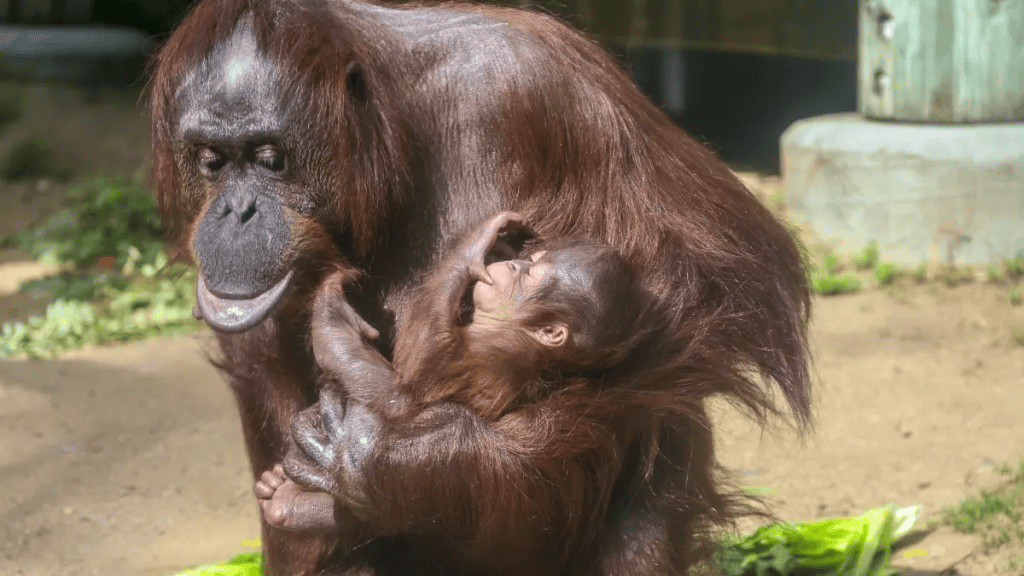
A heart-warming moment, reported on by the Los Angeles Times, has arrived at the Los Angeles Zoo: on October 10, 2025, a baby boy of the critically endangered Bornean orangutan species was born to mother Kalim and father Isim, marking the first birth of this species at the zoo in nearly 15 years.
Welcoming the Newborn
Kalim, age 43, already had two offspring and this arrival marks her third child—and her first with Isim (age 31). For the first several weeks, mom and baby remained off-view behind the scenes, bonding in privacy. Recently, they made their public debut in the “Red Ape Rain Forest” habitat at the zoo, allowing visitors to glimpse this new chapter of life.
Why This Birth Matters
This isn’t just a cute baby story—there’s significant conservation importance here. The Bornean orangutan is classified by the International Union for Conservation of Nature (IUCN) as critically endangered, with threats including climate change, mining, and clear-cutting of habitat in Borneo. By having successful births and raising infants in well-managed zoological settings, zoos like the L.A. Zoo can support species survival efforts, genetic diversity, and help raise public awareness about the wild challenges these animals face.
Fascinating Orangutan Facts
- Orangutans spend about 90% of their time in trees, using their long arms and grasping feet to navigate the canopy.
- Among primates, they are second only to humans in the amount of time mothers care for offspring — in the wild, that may be up to 8 years.
- They share approximately 97% of their DNA with humans, and are known to make and use simple tools, and even understand dozens of symbols for objects, numbers and commands.
Visitor Tips
If you’d like to visit and see Kalim and her baby, the best time is early in the morning, when they tend to be most active and visible. The L.A. Zoo is located at 5333 Zoo Drive in Los Angeles and is open from 10:00 a.m. to 5:00 p.m.
The newborn is still unnamed, and the zoo spokesperson mentioned they are considering whether to hold a naming contest or naming opportunity in the coming days.
The Bigger Picture
This birth reminds us that each individual animal matters—not just as an adorable baby on display, but as a member of a species teetering on the brink. For the Bornean orangutan, every successful birth and survival counts toward the broader mission of conservation.
Zoos such as L.A. Zoo play a dual role: providing top-level animal care and habitat enrichment, and serving as ambassadors for wild populations—educating visitors about the threats (deforestation, habitat fragmentation, climate change) and how humans can help.
How You Can Help
Even if you’re not able to visit in person, you can still make a difference:
- Support credible conservation organizations working on orangutan habitat in Borneo and Sumatra.
- Adopt sustainable consumption habits — for example, check that palm oil products are sustainable and deforestation-free, given how much orangutan habitat is lost for palm-oil plantations.
- Spread the word: share the story of Kalim and her baby, to help raise awareness of their species and what is at stake.
- Visit reputable zoos and support animal welfare and conservation-focused institutions; ask questions of staff and look for signage about how the animals are cared for and what is being done for their wild counterparts.