
For decades, a core assumption in science has been that great ape vocalizations are largely innate, automatic, and hardwired. Unlike human language, which we learn from our communities, an ape’s calls were thought to be a fixed repertoire, resistant to social influence. This idea was bolstered by historical experiments that famously failed to teach apes to speak, cementing the belief in a vast, unbridgeable gap between their communication and ours.
This painted a frustrating picture of our own origins. If our closest relatives were vocally locked in place, language must have exploded out of nowhere in the human lineage—an evolutionary event without a clear echo in the animal kingdom. The gap seemed to suggest that language appeared in a sudden leap, a uniquely human event with no clear precursors in our primate family tree.
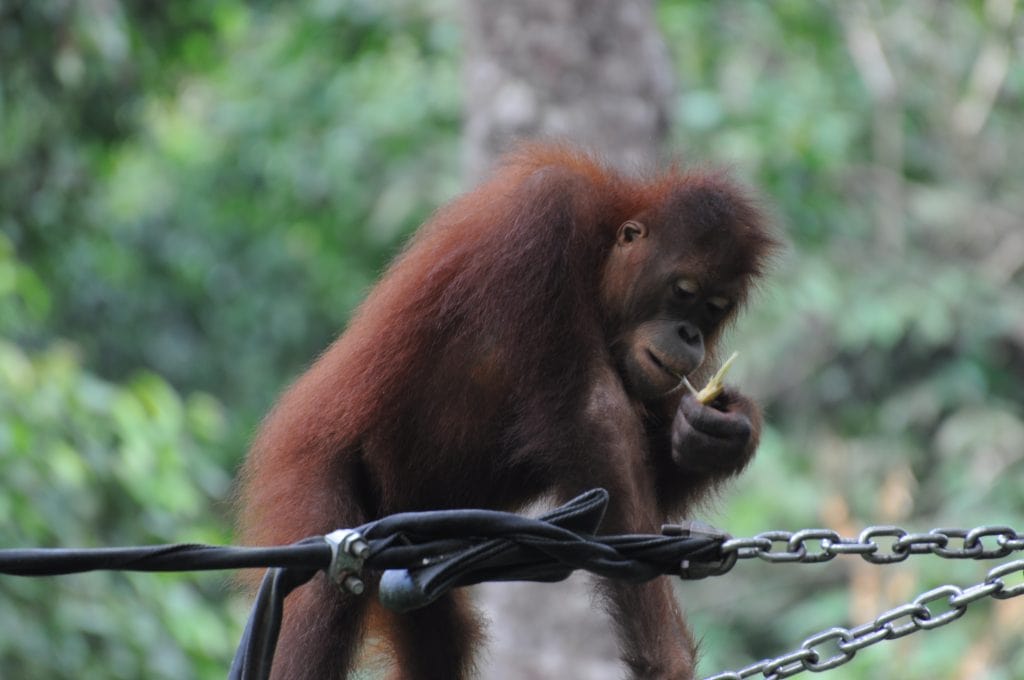
Now, a groundbreaking study on wild orangutans has turned this old assumption on its head. By observing six different populations in their natural habitat, researchers have uncovered a surprising and profound link between the social world of these apes and how they “talk,” offering a new window into the gradual evolution of spoken language.
Your Social Scene Shapes Your “Vocal Personality”
The study’s central finding is both simple and revolutionary: the density of an orangutan‘s community—how many other orangutans live nearby—directly predicts its vocal style. This social setting molds their alarm calls, creating distinct “vocal personalities.”
The researchers identified two clear vocal styles:
- In high-density populations, where social contact is more frequent, individual orangutans are vocally more original and acoustically unpredictable. They are vocal innovators, but their new call variants tend to be short-lived.
- In low-density populations, where social contact is less common, individuals are vocally more repetitive and acoustically conformative. They stick to a more consistent, shared set of sounds.
This is a major breakthrough. It provides the first non-invasive evidence from the wild that, just as in human communities, the social environment is a powerful force that shapes the vocal output of a great ape. Their calls are not simply hardwired; they are dynamically influenced by their social landscape. They are vocal trendsetters, but their innovations often fade quickly—a stark contrast to their more isolated cousins, who, paradoxically, build more complex vocal toolkits over time.
More Complex, Not Simpler: The Counter-Intuitive Power of a Quieter Life
One of the most counter-intuitive findings from the study is that individuals in the more “conformist” low-density populations actually exhibited more complex call repertoires. While the high-density groups were more innovative moment-to-moment, the low-density groups accumulated a greater variety of call variants over time.
To understand this, imagine the high-density groups as a crowded social media feed. New calls are like viral trends: they appear constantly but vanish just as fast in the social noise. In contrast, for an orangutan in a low-density group, a new call heard during a rare encounter is a valuable piece of information. That innovation is more likely to be remembered, adopted, and passed on, allowing a more complex and stable “dictionary” of calls to build up across the community over generations. This aligns perfectly with models of cultural evolution, which suggest dispersed populations with intermittent contact are the “best breeding grounds for the accumulation of new traits through social learning.”
This dynamic is a fascinating echo of our own past. The demographic pattern of scattered groups with occasional interaction is reminiscent of how ancient humans likely lived as they spread across the African continent, suggesting this social structure may have been a key ingredient in the early development of language.
How to Study Ape “Language” Without a Lab
Studying how great apes learn to vocalize presents significant challenges. The isolation experiments used to study vocal learning in songbirds or marmoset monkeys are “not, however, ethically permissible with great apes.” This ethical barrier has long limited our understanding and contributed to the idea that their vocal skills were innate.
To overcome this, the research team designed a clever study that took advantage of “natural experiments.” They didn’t need to manipulate the apes’ social lives in a lab; instead, they compared six wild orangutan populations that already lived in naturally different densities, from sparse to crowded.
To ensure they were measuring only the effect of the social environment, they focused on a very specific sound: the “kiss-squeak” alarm call. This call is universal across all orangutan populations and is frequently directed at neutral third parties, such as human observers. This methodological choice was critical: by studying a call directed at an external threat rather than at other orangutans, they could be certain they were measuring the passive, background influence of the social environment itself—the ‘radio station’ an orangutan is tuned to—not the content of its specific conversations.
The Roots of Language Are Deeper Than We Thought
These findings directly challenge the long-held notion that human language was a sudden evolutionary invention with no deep roots—what scientists call a “saltational” event. The idea that ape vocalizations were fixed and automatic created a chasm between us and them, making language seem like a miracle that appeared out of nowhere.
This research builds a crucial bridge across that evolutionary chasm. It provides strong support for a “new framework for the gradual evolution of spoken language” that began with our ancient hominid ancestors. The social mechanisms that shape how we speak today appear to have been at work in our family tree long before humans existed. The paper’s core conclusion states it plainly:
We confirm that like human learners exposed to different linguistic communities, social settings help modulate vocal output dynamics and structure in nonhuman hominids.
A New Conversation About Our Origins
This study reveals that the social world and the vocal world are deeply intertwined, not just for humans, but for our great ape relatives as well. The voices of orangutans are not static and predetermined but are actively molded by the community around them. This discovery opens up a new conversation about our own origins, one made all the more urgent by the fact that one of the six orangutan populations that taught us this lesson, Sampan Getek, is now extinct.
If an orangutan’s social life can shape its voice, what other abilities that we consider uniquely ‘human’ are we simply failing to notice in the animal world?