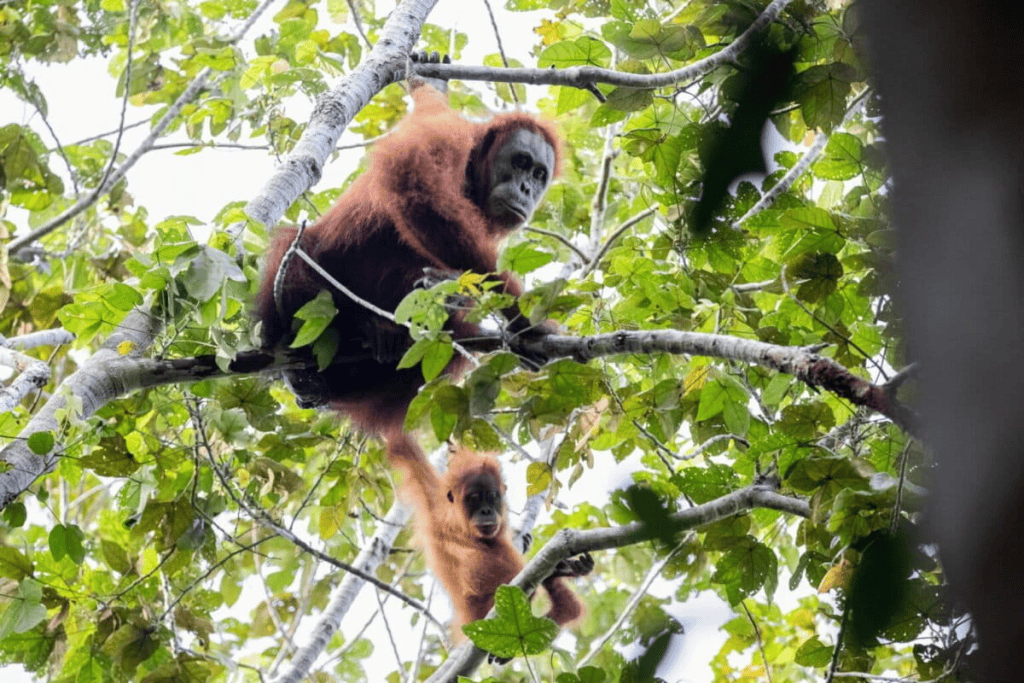
CENTRAL TAPANULI, INDONESIA – A significant discovery has reshaped our understanding of the world’s rarest great ape, the critically endangered Tapanuli orangutan (Pongo tapanuliensis). Researchers have confirmed a previously unknown cluster of the species inhabiting a nonprotected peat swamp forest 32 kilometers (20 miles) away from their only known range, the Batang Toru forest in North Sumatra.
This finding, confirmed via DNA analysis of fecal samples, marks the first recorded presence of Tapanuli orangutans outside the Batang Toru landscape. While offering a rare opportunity to expand knowledge of the species’ range, it also brings serious conservation challenges due to the extreme vulnerability of the new habitat.
The World’s Rarest Ape Under New Threat
The Tapanuli orangutan, first described as a new species in 2017, is already one of the most threatened great apes globally, with the main Batang Toru population estimated at only around 800 individuals. This species holds the oldest evolutionary history of any orangutan species, having diverged from its common ancestor approximately 3.4 million years ago.
The newly documented population resides in the secondary forest of Lumut Maju village in Central Tapanuli district. Conservation efforts have been focused here since 2022, when local residents first reported sightings to the Sumatran Orangutan Conservation Foundation–Orangutan Information Centre (YOSL-OIC). Verification and monitoring, including the identification of new nests, confirmed the active use of the 1,234-hectare (3,049-acre) peat swamp by orangutans. DNA testing later verified them as Tapanuli orangutans.
Crisis in a Nonprotected Zone
The critical concern for this newly identified cluster stems from its location: a peat swamp forest designated as nonprotected land. This nonprotected zoning designation leaves the forest highly susceptible to rapid land clearing, particularly for oil palm plantations.
Tragically, this threat is already manifesting rapidly. Researchers note that in 2025 alone, there has been exceptional land clearing, leaving the remaining forest in Lumut Maju at less than 1,000 hectares (2,500 acres). The expansion of oil palm plantations and the roar of heavy machinery underscore how quickly this valuable habitat is being lost.
Isolation Requires Urgent Action
The Lumut Maju population is estimated to consist of fewer than 100 individuals. This number falls significantly short of the expert assessment that a viable orangutan population requires at least 250 individuals living in a connected natural forest with sufficient food.
Due to the heavy fragmentation of the landscape between Lumut Maju and Batang Toru by plantations and infrastructure, reestablishing a forest corridor is considered impractical. Consequently, conservation experts state that relocation is the most realistic long-term strategy to secure their survival. Moving these apes to the larger, protected Batang Toru block could help boost genetic diversity and secure their future.
However, any relocation efforts must be carefully managed to ensure that the destination area in Batang Toru has adequate forest canopy and that conflict with local residents is prevented.
The Lumut Maju cluster is currently under close scientific study to determine if it holds unique genetic traits—which would make it a crucial genetic reservoir—and to assess whether it can survive current habitat pressures or if relocation is inevitable.
The Path to Sustainable Coexistence
Beyond the immediate crisis in Lumut Maju, the wider Tapanuli orangutan population in Batang Toru faces escalating threats from human activities, including gold mining, hydropower construction, agricultural expansion, and planned road development.
Habitat fragmentation has reduced natural food sources, often forcing orangutans onto nearby farms. Sustainable coexistence remains possible if conservation strategies are implemented that integrate both the ecological needs of the orangutans and the economic realities of local communities. Researchers emphasize that cohabitation, rooted in behavioral adjustment between species and the use of local knowledge, should result in increased animal populations while communities continue to receive social legitimacy and economic benefits.
This story was originally reported on by Junaidi Hanafiah/Mongabay Indonesia