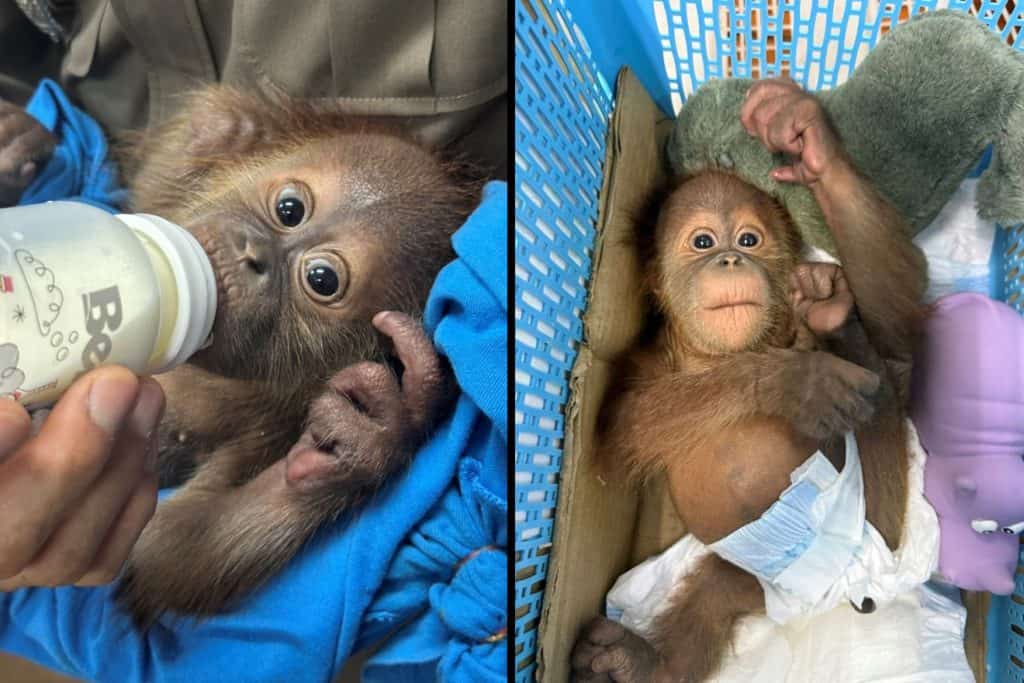
In the early hours of May 14, 2025, Thai police arrested a man at a gas station in Bangkok as he prepared to hand over two infant orangutans to a buyer. The operation, coordinated by Thailand’s Natural Resources and Environmental Crime Suppression Division and supported by the U.S. Fish and Wildlife Service’s Office of Law Enforcement, intercepted what authorities say was a trafficking attempt between Indonesia and Thailand. (U.S. Fish & Wildlife Service)
The suspect was charged with possession of protected wildlife. According to the Associated Press, police said the two infants—one approximately a year old and the other only about one month—were found in a basket strapped to the courier’s motorcycle.
Thailand’s Department of National Parks, Wildlife and Plant Conservation took custody of the animals. The younger infant required intensive medical care, including time in an incubator, while the older was transferred to a local wildlife sanctuary for ongoing care (U.S. Fish & Wildlife Service).
What This Case Confirms — and What Remains Unclear
✔ Confirmed Facts
- International cooperation: The arrest and seizure were enabled by collaboration among Thai law enforcement, the U.S. Fish & Wildlife Service’s Bangkok Attaché Office, the Wildlife Justice Commission, and the United Nations Office on Drugs and Crime (UNODC). (FWS article)
- Transit hub role: Thailand continues to serve as a critical transit point in the wildlife trafficking chain, bridging source countries like Indonesia and Malaysia with markets across Asia. (Royal Thai Embassy)
- Street value estimates: Police told the Associated Press that baby orangutans can fetch roughly 300,000 baht (about USD 9,000) each on the black market.
- Legal context: Orangutans are listed under CITES Appendix I, prohibiting international commercial trade in the species — a treaty Thailand has ratified and enforces through national law. (FWS)
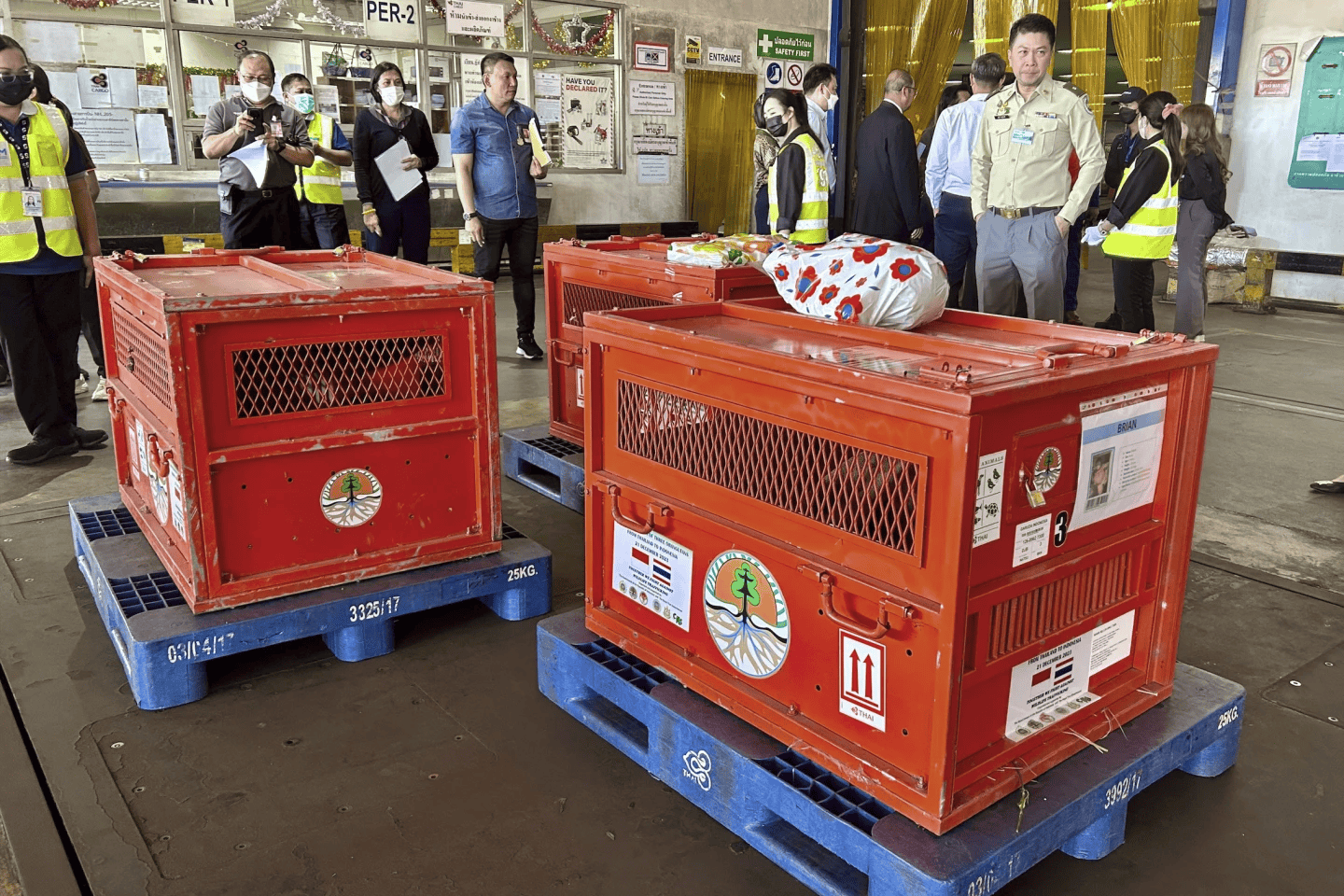
- Regional precedent: This is not Thailand’s first case. In December 2023, authorities repatriated three rescued orangutans — Nobita, Shizuka, and Brian — back to Indonesia through an international operation. (Associated Press)
⚠ Still Unclear
- Capture origin: Neither the FWS article nor Thai reports specify where the infants were taken from in Indonesia.
- Network scope: The FWS report identifies the courier but not higher-level coordinators or end buyers.
- Survivorship rate: Though conservation groups often cite mortality multipliers in orangutan trafficking (e.g., many adults killed per infant taken), this case’s data doesn’t confirm those ratios.
Why This Case Matters in 2025
1. Persistent Trafficking Despite Awareness: Despite years of campaigns and education, wildlife traffickers continue to target high-profile species like orangutans, exploiting gaps in enforcement and online platforms.
2. Profit Outweighs Protection: With prices estimated at nearly USD 9,000 per infant (AP News), the financial incentive remains strong, fueling a trade that is as profitable as it is cruel.
3. Weak Points in Transit Enforcement: The Bangkok seizure demonstrates how traffickers rely on small-scale couriers using motorbikes and local transport routes, evading detection through simple concealment rather than sophisticated logistics.
4. International Partnerships Make the Difference: The success of this operation underscores how cross-border intelligence sharing — between Thai authorities, the U.S. Fish & Wildlife Service, and partners like the Wildlife Justice Commission — is essential to dismantling organized wildlife crime.
The Bigger Picture
This seizure is part of a growing pattern. In earlier operations, Thai authorities have intercepted similar shipments, including the 2023 repatriation of three orangutans and a 2025 case involving three additional infants smuggled from Indonesia via Malaysia. These cases collectively highlight Thailand’s dual role as both trafficking corridor and enforcement frontier.
The challenge now lies in closing those gaps. While enforcement actions save individuals, they are often reactive — seizing animals only after the trauma of capture, transport, and attempted sale. True prevention requires addressing both supply (forest protection, livelihood alternatives) and demand (public education, pet trade reduction, stricter penalties).
A Call to Action
The 2025 Bangkok seizure offers a stark reminder that orangutan trafficking remains active, profitable, and organized. Each confiscated infant represents a life disrupted — and likely, several more lost in capture.
To protect orangutans and the forests they anchor, governments, conservation organizations, and consumers must work together:
- Continue ethical education and outreach campaigns to curb demand for captive wildlife
- Regulate digital wildlife trade, often conducted on encrypted messaging platforms.
- Invest in rehabilitation centers and sanctuaries to provide long-term care for confiscated individuals.
- Expand demand-reduction campaigns in destination countries to curb exotic pet ownership.
- Protect and restore orangutan habitats, reducing the need for capture in the first place.
Every infant rescued is a victory — but prevention is the only sustainable path forward.
Related sources:
- U.S. Fish & Wildlife Service – “Stopping Orangutan Trafficking in Thailand” (May 2025)
- Associated Press – “Thai police rescue 2 baby orangutans…” (May 2025)
- The Nation (Thailand) – “Two baby orangutans rescued…” (May 2025)
- Royal Thai Embassy (Washington DC) – “With American Help, Thailand Arrests Orangutan Smugglers”
- Thai PBS World – “Police seize 3 baby orangutans smuggled from Indonesia via Malaysia” (2025)
- Associated Press – “Thailand sends 3 orangutans rescued from wildlife smugglers back to Indonesia” (2023)